
Last updated on September 25th, 2026 at 06:26 pm
Your teenager says “fine” while staring at the floor, and your boss says “great job” without looking up from her laptop. In both cases, the words say one thing and everything else says another, and you instinctively believe everything else.
Nonverbal communication is everything you communicate without words, from a raised eyebrow and a firm handshake to the pause before you answer.
It runs through every conversation, at the dinner table, in the office, at the market, and in your text messages.
This guide explains the main types of nonverbal communication, what these cues actually do, and how much of communication is really nonverbal.
It also covers what research says about reading people, how cues differ across cultures, and practical ways to improve your own nonverbal skills.
It belongs to our human communication guide, which covers every major communication type.
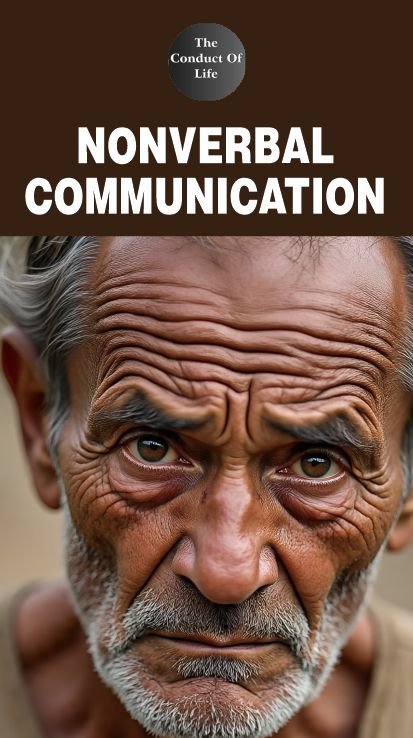
Table of Contents
What Is Nonverbal Communication?
Nonverbal communication is the transfer of meaning through facial expressions, eye contact, gestures, posture, touch, space, voice quality, appearance, and even timing. Body language is the best-known part of it, and our body language guide covers those signals in detail. Nonverbal cues rarely travel alone, because they wrap around your words and change how people hear your verbal communication. Online, emojis, punctuation, and reply speed quietly do the same job, which is why a late “ok.” can feel so cold.
How Much of Communication Is Nonverbal?
You may have heard that 93 percent of communication is nonverbal, but that popular figure is a misreading of limited research. Psychologist Albert Mehrabian has said his findings apply only to communicating feelings and attitudes, especially when words and tone conflict. The honest answer is that it depends on the situation, since a train announcement relies on words while a tense family dinner relies heavily on faces and silences. Voice matters more than people expect, and research by Yale’s Michael Kraus found listeners read emotions more accurately from voice alone than from voice and face together.
Types of Nonverbal Communication
Communication researchers group nonverbal cues into several channels, and most moments use a few of them at once.
Facial Expressions
Your face can signal interest, confusion, warmth, or irritation within seconds, which is why a smile at a market stall can soften any bargain.
Eye Contact
Eye contact signals attention and confidence in many cultures, though some people, including many who were taught to lower their eyes before elders, read steady eye contact as disrespect.
Gestures
Gestures like a wave, a thumbs-up, or pointing add emphasis or replace words, but their meaning changes from one country to another.
Posture and Body Movement
Leaning in, turning toward someone, or slumping in a meeting chair all signal your engagement, and our guide on body language that commands respect shows how posture affects impressions.
Touch
A hug from your mother, a pat on a friend’s shoulder, and a handshake at a job interview each carry very different messages. Comfort with touch varies widely, so our guide to physical boundaries is worth reading before assuming a hug is welcome.
Personal Space
How close you stand says a lot, from the easy closeness of family on a sofa to the careful gap between strangers in a bank queue.
Voice
Tone, pitch, pace, and volume, known as paralanguage, can turn “nice shoes” into a compliment or a joke at your expense.
Appearance
Clothing, grooming, and accessories send messages before you speak, which is why people dress differently for a wedding, a funeral, and a Saturday hangout.
Time
Arriving late, replying days later, or giving someone your full afternoon all communicate how much you value the person and the moment.
What Nonverbal Cues Do
Nonverbal cues work alongside words in a handful of ways, and noticing which one is happening helps you read people better.
- Repeating: nodding while saying yes, or pointing while giving directions to a lost visitor at the mall.
- Complementing: a warm smile that adds sincerity to “congratulations” at a friend’s graduation party.
- Substituting: a thumbs-up across a noisy room or a look from your mother that needs no words at all.
- Contradicting: saying “I am not angry” through clenched teeth, which usually leaves people believing the teeth.
- Regulating: raising a hand in a meeting, or glancing at the door when a conversation should end.
- Accenting: tapping the table or raising your voice to underline the one point that matters most.
Can You Really Read People?
Popular articles promise you can read anyone like a book, but the research is far more humbling.
A 2019 review led by Lisa Feldman Barrett concluded that people express the same emotion with different facial movements, and different emotions with similar ones, depending on context. A scowl might mean anger, but it might also mean concentration, confusion, or bright sunlight in someone’s eyes.
Lie detection is harder still, since a meta-analysis of 206 documents by Charles Bond and Bella DePaulo found people judge lies and truths correctly only 54 percent of the time.
DePaulo’s research also found no single cue, such as avoiding eye contact, that reliably signals deception. Treat cues as prompts for a gentle question, not verdicts, and our guide to social cues shows how to read them in context.
Check out this post on physical cues which covers what the body does under stress, anger, and other strong states.
Nonverbal Communication Across Cultures
The same gesture can be friendly in one place and offensive in another, so travel and multicultural workplaces call for extra care. Comfortable speaking distance, the meaning of silence, and rules about touch between men and women all vary between cultures and communities. Generations differ too, since younger people may read a full stop at the end of a text as anger while older relatives see simple good grammar. Our guide to cultural intelligence explains how to adjust your signals when you step outside familiar settings.
How to Improve Your Nonverbal Communication Skills
Better nonverbal skills come from awareness and practice rather than memorized tricks.
- Match your body to your words: if you say “I am listening,” turn toward the person and put the phone away.
- Watch clusters, not single cues: crossed arms alone might mean cold air, but crossed arms plus short answers deserve a gentle check-in.
- Know the baseline: notice how someone normally behaves, so you can spot real changes instead of misreading their usual habits.
- Ask instead of assuming: a simple “You seem quiet today, is everything okay?” beats silently deciding what someone’s face means.
- Record yourself: watching a video of yourself presenting reveals habits like fidgeting or looking away that you never noticed.
- Build emotional awareness: the better you read your own feelings, the better you read others, as our guide on emotional awareness and nonverbal skills explains.
Pair these habits with active listening, since reading someone well starts with giving them your full attention.
Conclusion
Nonverbal communication covers faces, eyes, gestures, posture, touch, space, voice, appearance, and time, and it colors every word you say. It matters enormously, but not in the exaggerated way popular statistics suggest, and no single cue reliably reveals a lie. Read cues in clusters and context, respect cultural differences, and ask when you are unsure. This week, notice one gap between what someone says and how they say it, and gently ask about it instead of guessing. Read our body language guide to sharpen what you notice in everyday conversations.
Frequently Asked Questions
What is nonverbal communication?
Nonverbal communication is sending messages without words, through facial expressions, eye contact, gestures, posture, touch, personal space, tone of voice, appearance, and even how you use your time.
What are the types of nonverbal communication?
The main types are facial expressions, eye contact, gestures, posture and movement, touch, personal space, paralanguage such as tone and pitch, physical appearance, and the use of time.
Can body language tell if someone is lying?
Not reliably, because a meta-analysis by Bond and DePaulo found people judge lies and truths correctly only 54 percent of the time, barely better than pure chance guessing.
How can I improve my nonverbal communication skills?
Match your body language to your words, read cues in clusters rather than alone, learn people’s normal behavior, record yourself speaking, and gently ask instead of simply assuming.

Pious Clements writes about character, conduct, and the deeper questions of how a life is lived. He is the founder of The Conducts of Life, a site built on the belief that how you behave, not what you achieve, defines who you are. His writing draws from decades of observation, lived experience, and serious thinking about human nature, ethics, and self-development. He writes to be useful, not popular.