Last updated on September 27th, 2026 at 07:01 am
A defense lawyer believes her client is guilty, yet she argues for his acquittal with everything she has. Her personal morals may be uneasy, but her professional ethics require a vigorous defense, and that tension shows how the two differ.
Ethics and morals are close cousins, and in casual conversation many people swap one word for the other without a second thought.
Yet the difference matters when your conscience and your job point in different directions, or when your family’s values clash with the rules of your workplace.
This article defines both terms, compares them side by side, and walks through real examples from law, medicine, journalism, and daily life.
It also explains what happens when the two conflict and how to respond when they do. For the broader picture, start with ethics and morality explained in this main guide.
Table of Contents
The Meaning of Ethics and Morals
Morals are the personal beliefs about right and wrong that guide how you live, usually absorbed from family, faith, culture, and experience.
Ethics are the shared standards of conduct that a group, profession, or society agrees on, as well as the philosophical study of right and wrong.
The words even have similar roots, since ethics comes from the Greek ethos, meaning character or custom, and morals from the Latin mores, meaning customs.
A simple way to remember the difference is that morals live inside you, while ethics are agreed upon between people.
Ethics vs Morals: Key Differences
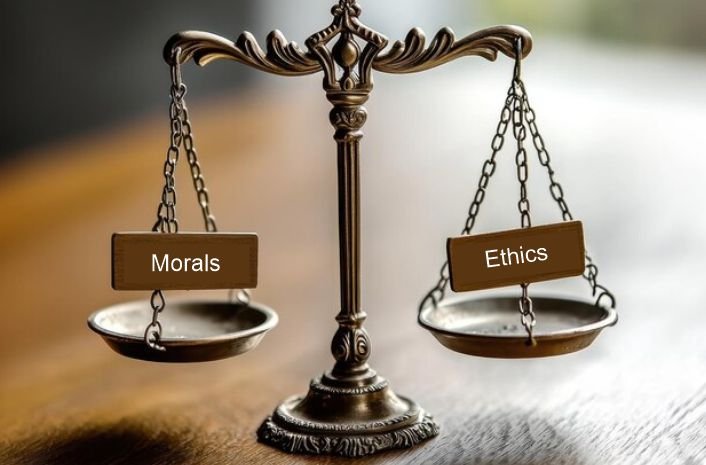
The table below sets out the main differences, though in real life the two constantly overlap.
| Morals | Ethics | |
|---|---|---|
| Source | Personal conscience, family, faith, and culture | Professions, institutions, and society |
| Scope | Guides one person’s life | Guides a group’s conduct |
| Form | Usually unwritten and felt | Frequently written as codes and policies |
| Flexibility | Can shift with personal growth or faith | Changes through formal revision or law |
| Consequence of breaking | Guilt, shame, or loss of self-respect | Discipline, dismissal, or loss of license |
| Example | “I believe lying is wrong.” | “Doctors must keep patient records confidential.” |
Where Each One Comes From
Morals take root early, as children watch how parents treat others, absorb religious teachings, and learn what their community praises or condemns. Our guide to how a moral compass forms traces that process in detail.
Ethics are usually written down by groups that need members to behave predictably, such as medical boards, bar associations, newsrooms, and companies.
These codes let strangers trust a profession, because you can expect any licensed doctor to keep your medical history private, regardless of their personal views.
Our article on integrity in business shows how shared ethical standards build that kind of trust at work.
Real-Life Examples of Ethics and Morals in Action
The Defense Lawyer
Legal ethics require lawyers to defend clients vigorously and keep their confidences, even when a lawyer’s personal morals recoil at what the client may have done. The system depends on everyone getting a defense, so the ethical duty wins in the courtroom.
The Doctor
A doctor may personally disapprove of a patient’s smoking or drinking, yet medical ethics require treating that patient with the same care and respect as anyone else.
The Journalist
Journalistic ethics protect confidential sources, so a reporter may refuse to name a source even under legal pressure, because breaking that promise could damage trust in the profession.
The Employee
An accountant’s morals say never lie, and professional ethics agree, so when a manager asks her to hide losses, both her conscience and her code point the same way.
At Home
Family life runs mostly on morals rather than formal ethics, such as a parent’s belief that children should always tell the truth, even when it costs them. Our guide to ethical dilemmas in practice offers frameworks for the harder cases.
When Ethics and Morals Conflict
Conflict arises when a professional code asks you to do something your conscience rejects, or when your morals push you to break a rule you agreed to follow.
In 1984, philosopher Andrew Jameton described moral distress in nursing as the strain of knowing what is right while workplace rules or shortages block you from acting on it.
When the clash is severe, the damage can go deeper than distress. Psychologist Brett Litz and colleagues described moral injury as lasting harm from committing, failing to prevent, or witnessing acts that break a person’s deepest moral beliefs.
In a nationally representative survey of 3,002 U.S. veterans, 44.7 percent reported at least one potentially morally injurious event.
Moral injury is not limited to war, and doctors, nurses, and first responders can experience it when rules or shortages force painful choices.
Conscientious objection offers one recognized route, allowing some professionals to decline specific tasks that violate their morals while ensuring someone else provides the service.
Why the Distinction Matters
Knowing which is which helps you respond wisely when you feel uneasy about a rule or request.
If the unease comes from your morals, the question is how much you can compromise without betraying yourself.
If it comes from a broken ethical code, you may have a duty to report it.
The distinction also builds tolerance, since colleagues can hold very different personal morals and still work together under one shared code.
In my observation, people who respect both their conscience and their commitments earn the deepest trust, which is the heart of what integrity really requires.
How to Handle a Clash Between Your Morals and Workplace Ethics
If your conscience and your job start pulling in different directions, these steps can help you act without regret.
- Name the conflict precisely: write down which personal belief and which rule are colliding.
- Check the actual code: read the policy or professional standard, since the conflict may be smaller than it first appears.
- Talk to someone you trust: a mentor, ethics officer, or professional body can offer options you have not considered.
- Look for a principled middle path: such as asking to be reassigned from one task rather than refusing your whole role.
- Know your line: decide in advance what you will not do, so pressure in the moment does not decide for you.
- Seek support if it weighs on you: lingering guilt, shame, or anger after a morally painful event is worth discussing with a licensed counselor.
Conclusion
The defense lawyer is not a hypocrite; she is honoring a professional ethic that protects everyone’s right to a fair trial, even while her morals feel uneasy.
Morals are the personal beliefs you carry inside, while ethics are shared standards groups agree on, and most of the time they point the same way.
When they clash, naming the conflict, checking the code, and seeking wise counsel protect both your conscience and your commitments.
Take a moment this week to write down one line you would never cross, whatever the pressure.
Frequently Asked Questions
What is the main difference between ethics and morals?
Morals are personal beliefs about right and wrong drawn from family, faith, and culture, while ethics are shared standards of conduct agreed on by groups, professions, or society.
Can someone be ethical but not moral?
Yes, a person can follow every professional rule while privately acting against their conscience, and a moral person can sometimes break a workplace rule they believe is wrong.
What is moral injury?
Moral injury is lasting harm from committing, failing to prevent, or witnessing acts that violate deeply held moral beliefs, first described among veterans and now recognized in healthcare.
What should I do if my job conflicts with my morals?
Name the conflict, check the actual policy, talk to a mentor or ethics officer, look for a middle path like reassignment, and decide your firm limits in advance.
Disclaimer: This article is for informational and reflective purposes only and does not constitute mental health, psychological, or therapeutic advice. The author is not a licensed therapist or psychologist. Where content is based on personal observation or experience, this is stated clearly in the article. If you are struggling with your mental health, please consult a qualified mental health professional.

Pious Clements writes about character, conduct, and the deeper questions of how a life is lived. He is the founder of The Conducts of Life, a site built on the belief that how you behave, not what you achieve, defines who you are. His writing draws from decades of observation, lived experience, and serious thinking about human nature, ethics, and self-development. He writes to be useful, not popular.